Training · Mentoring · Talks

AI and software development training for tech professionals and teams.

Learn to bring artificial intelligence into the software development lifecycle, from productivity tools to the architecture and production rollout of intelligent systems.

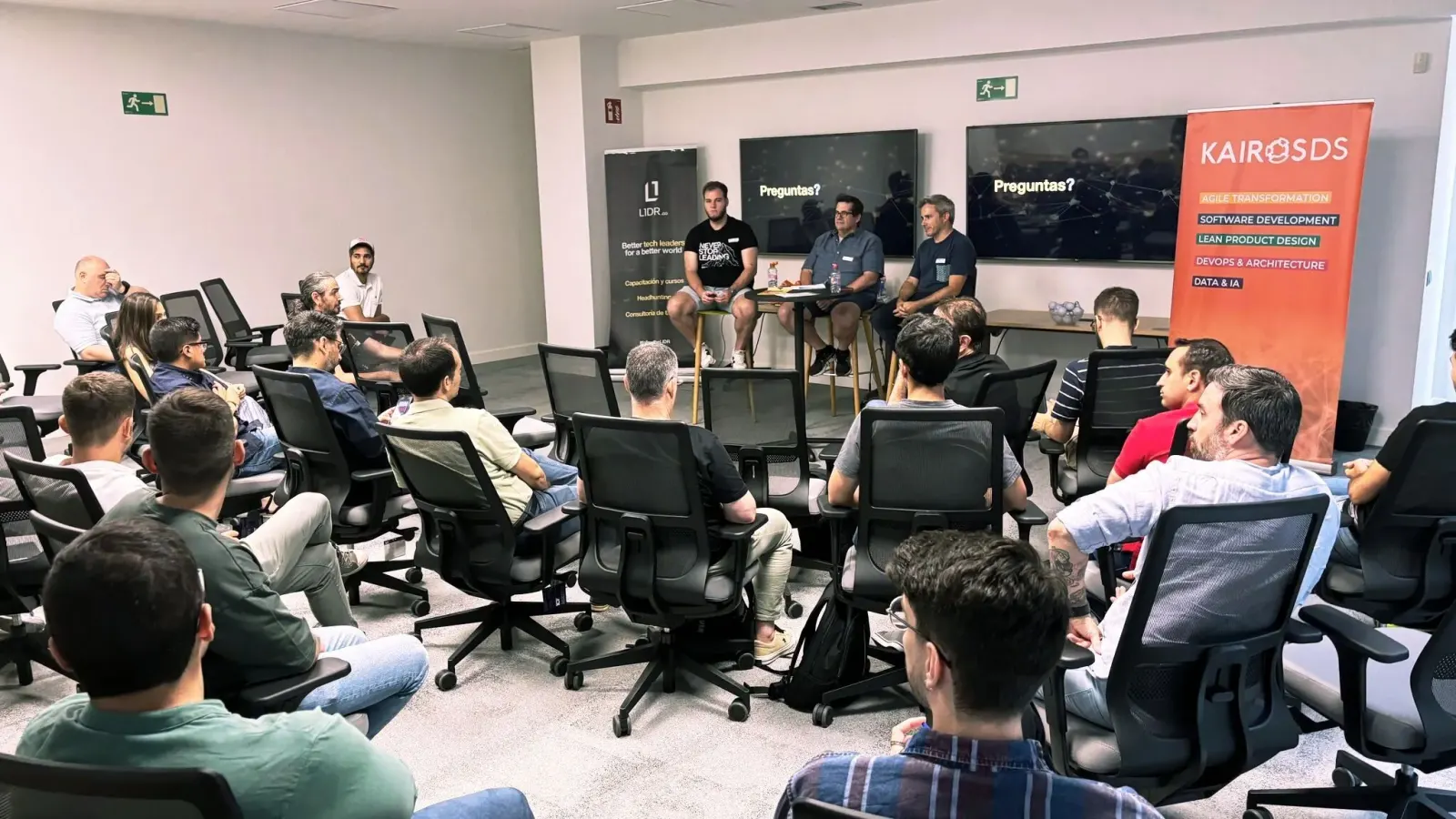
Daniel Gil speaking on a panel discussion in front of an audience of developers
Daniel GilOn a panel discussion

In figures

Teaching experience, in figures.

Classes taught and scheduled
32+
Includes sessions already scheduled.
Training hours taught and scheduled
64+
Includes hours already scheduled.
Professionals trainedEstimate
≈ 720+
Based on 13 cohorts of 30–60 participants.
ROTI rating
4+/5
Return On Time Invested, as rated by attendees.

Figures from my work as a mentor at LIDR, in the AI Engineer and AI4Devs programmes. Classes and hours include sessions already scheduled; professionals trained is an estimate.

Training areas

Four areas, one development lifecycle.

Content is organised around real engineering problems, not isolated tools. Each programme combines the areas your team needs.

AI-Assisted Software Engineering

How to use AI across the whole development lifecycle.

  • Harness Engineering
  • Spec-Driven Development
  • AI-assisted planning and documentation
  • AI applied to frontend and backend
  • AI-assisted testing and software quality
  • Development workflows with coding assistants

What your team takes away

A way of working with AI that fits your team: what to delegate, how to specify it and how to review it.

AI Engineering and LLM architectures

Designing and integrating AI solutions into real applications.

  • Integrating LLMs through APIs
  • Context management
  • RAG and CAG
  • Embeddings and vector databases
  • Information processing and retrieval
  • Modular AI architectures

What your team takes away

Judgment to design an LLM-based feature: which context it needs, how to retrieve it and how to structure it.

Agents and intelligent systems

Building systems that use tools, make decisions and run processes.

  • Tool calling
  • AI agents
  • Workflow orchestration
  • LangChain and LangGraph
  • Multi-agent systems
  • Evaluation, observability and production

What your team takes away

Knowing when an agent is the right answer, how to build it and what it takes to run it in production.

Practical AI applications

Building working solutions through exercises and demos.

  • Documentation chatbots
  • RAG with LangChain and Streamlit
  • Reading and interpreting images
  • Video processing and audio transcription
  • Web search and external sources
  • Integrating multimodal capabilities

What your team takes away

Working examples your team can use as the starting point for its own prototypes.

Collaboration formats

From a team programme to a single talk.

Format and length are agreed in each case, based on technical level, stack and goals. There are no off-the-shelf programmes.

Technical mentoring

Support for professionals or teams who need guidance on architecture, implementation and good practice.

ForIndividuals and teams

Talk about mentoring

Talks and conferences

Talks on AI Engineering, productivity, new methodologies and how software development is changing.

ForEvents and organisations

Propose a talk

Teaching experience

Real experience training tech professionals.

I work as a mentor at LIDR in two separate programmes, AI Engineer and AI4Devs, where I have taken part in 13 cohorts of software professionals.

I teach technical sessions on AI-assisted development, AI Engineering, RAG, agents and software architecture, combining fundamentals, live demos and hands-on exercises.

Organisation
LIDR
Programmes
AI Engineer · AI4Devs
Role
Mentor
Cohorts
13

Session topics

  • AI-assisted development
  • AI Engineering
  • RAG
  • Agents
  • Software architecture

My teaching approach

Less isolated theory. More applied engineering.

I teach the way I work: understanding the problem, building a solution and being honest about its limits.

  1. Fundamentals

    Understand how each technology works and when it makes sense to use it.

  2. Practice

    Learn through demos and working examples, not slides alone.

  3. Technical judgment

    Discuss architecture decisions, trade-offs and limitations openly.

  4. Real application

    Connect what you learn with the everyday problems of development and product.

Daniel Gil
Daniel GilLinkedIn

About me

An engineer who also teaches.

I am a software engineer, technology consultant and mentor specialising in digital products and artificial intelligence.

My experience combines architecture, development, technical leadership and product building. That lets me teach from a practical perspective, not a purely academic one.

  • Software architecture
  • Software engineering
  • Technical leadership
  • Digital product
  • AI Engineering
More about me

Contact

Want to bring AI to your development team?

Let’s design a programme adapted to your technical level, tools and goals.

or email me at daniel@doublysoft.dev
  1. 01
    Initial conversation

    Your team, your stack and what you want to achieve. No commitment.

  2. 02
    Tailored proposal

    Format, content and length, agreed together.

  3. 03
    Training

    Sessions with demos and exercises applied to your context.